
Since the Hearing Professional Conduct and Complaints Body Ltd (HPCCB) began its operations in October 2024, no complaints have escalated to a formal investigation and hearing.
This guidance therefore focusses on stages that commonly, but not necessarily always, occur in our informal resolution process. More detail on the HPCCB’s mediation and formal investigation and hearing processes are available in the HPCCB Complaints Management and Resolution Procedure by-law.


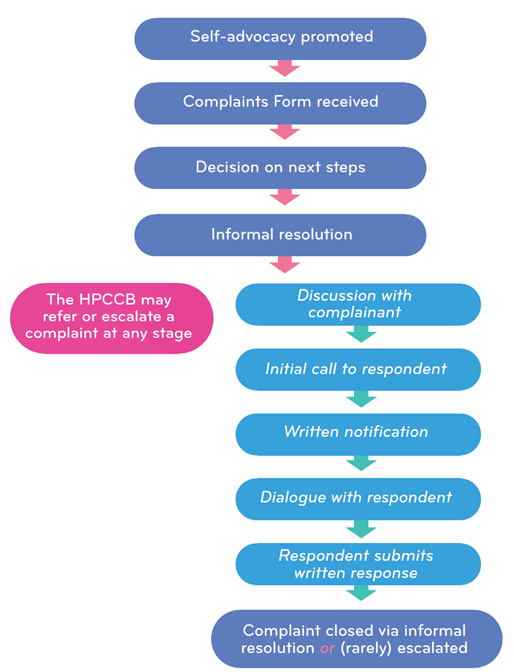
1. Self-advocacy promoted
A complaint is not considered ‘received’ by the HPCCB until the completed Complaints Form is submitted.
If a person contacts the HPCCB with concerns without submitting a completed Complaints Form, options for resolution without HPCCB involvement are explored.
This may include providing the person with the information needed to self-advocate or connecting the person with a consumer advocacy service.
Information on how to make a complaint to the HPCCB and/or any other relevant complaints entity or regulatory body (e.g. funding agency) is also provided.
Key terms
Respondent: The audiologist or audiometrist who the complaint is about.
Complainant: The person who made the complaint to the HPCCB. This may be a hearing services client, or another person with the legal authorisation to act on the client’s behalf.
The client: The person, if any, who received the hearing services the complaint relates to.
2. Completed Complaints Form received
If the complaint relates to a hearing service provided to a particular client, the complainant must consent to the respondent receiving the full details of the complaint and the HPCCB viewing the client’s relevant health records.
3. Decision on next steps
In general, the HPCCB handles all complaints they receive and have no ‘lower threshold’.
Occasionally, the complaint is not about an audiologist or audiometrist and the complainant is provided with information on the appropriate complaints handling entity or funding body to contact.
The HPCCB may decide that a complaint is frivolous or vexatious, or is covered by another complaint handled by the HPCCB and decide not to handle it, but this is very rare.
The HPCCB may refer to another complaints entity or escalate at any stage in its complaints handling process.
4. Informal resolution
If at any stage the informal resolution process becomes inappropriate or is unsuccessful, the complaint may proceed to mediation or a formal investigation and hearing.
Discussion with complainant
The Ethics Officer will always attempt to communicate with the complainant and, if possible, the client (if the client is not the complainant) as a first step in the informal resolution process to:
- ask if they have tried to resolve their concerns directly; in almost all cases, they have attempted this but in rare cases, they feel too unsafe to do so,
- explore if a consumer advocate may facilitate resolution, and
- ask if they are open to direct contact from the respondent in an attempt to resolve the matter.
Initial call to respondent
The Ethics Officer will always attempt to talk to the respondent as a first stage in handling the complaint. The Ethics Officer will call the respondent on their personal mobile, if their full name is known and their professional body has their mobile number. This discussion is to:
- give a brief overview of the complaint,
- encourage them to take time to consider the complaint before responding,
- encourage them to seek support from a trusted peer, manager, friend or legal professional,
- clarify that the HPCCB does not require the respondent to notify their employer,
- if relevant, suggest that they contact their indemnity insurer,
- explain that the written notification of complaint will be formal in its tone, and
- encourage them to call the Ethics Officer at any stage if they have questions or concerns.
The HPCCB can connect respondents with a peer for confidential support.
Written notification
The complainant receives a formal notification of the complaint which includes:
- full details of the complaint,
- client records (if provided) or consent for the HPCCB to view these,
- key concerns being considered by the HPCCB and the potential breaches of requirements under the Code of Conduct for audiologists and audiometrists, and
- information on support available to the respondent.
Dialogue with respondent
Often, the informal resolution process involves many calls and/or emails where a mutual understanding of the complainant’s and HPCCB’s expectations and the respondent’s views and planned future actions is sought. The respondent may choose to share draft(s) of their written response with the Ethics Officer for feedback.
Respondent submits written response
The Ethics Officer shares the written response with the HPCCB Chairperson before deciding whether to close the complaint.
5. Complaint closed or (rarely) escalated
If a complaint is closed via informal resolution, the Ethics Officer notifies the respondent as soon as possible after the written response is received. The complainant is also notified of the outcome of the informal resolution process.
Complaints resolved via informal resolution are not published or shared with professional body(ies). This means that complaints resolved via informal resolution by the HPCCB do not go on the respondent’s professional body membership record.
If the complaint is instead escalated to mediation or a formal investigation, the complainant receives information on next steps.
Mediation is an option rarely used as both parties must share the costs and many hearing services clients cannot afford this. It is best suited to disputes between two professionals.
A formal investigation and hearing is conducted by an independent panel that reports to the HPCCB Board if any breaches of the Code of Conduct for audiologists and audiometrists are identified. The respondent is given the opportunity to appeal this process before the HPCCB recommends any sanctions to the relevant professional body(ies).